AI Software Factory — How Is Software Development Changing?
 Tharuka Sarathchandra · Oct 30, 2026 · 3 min read
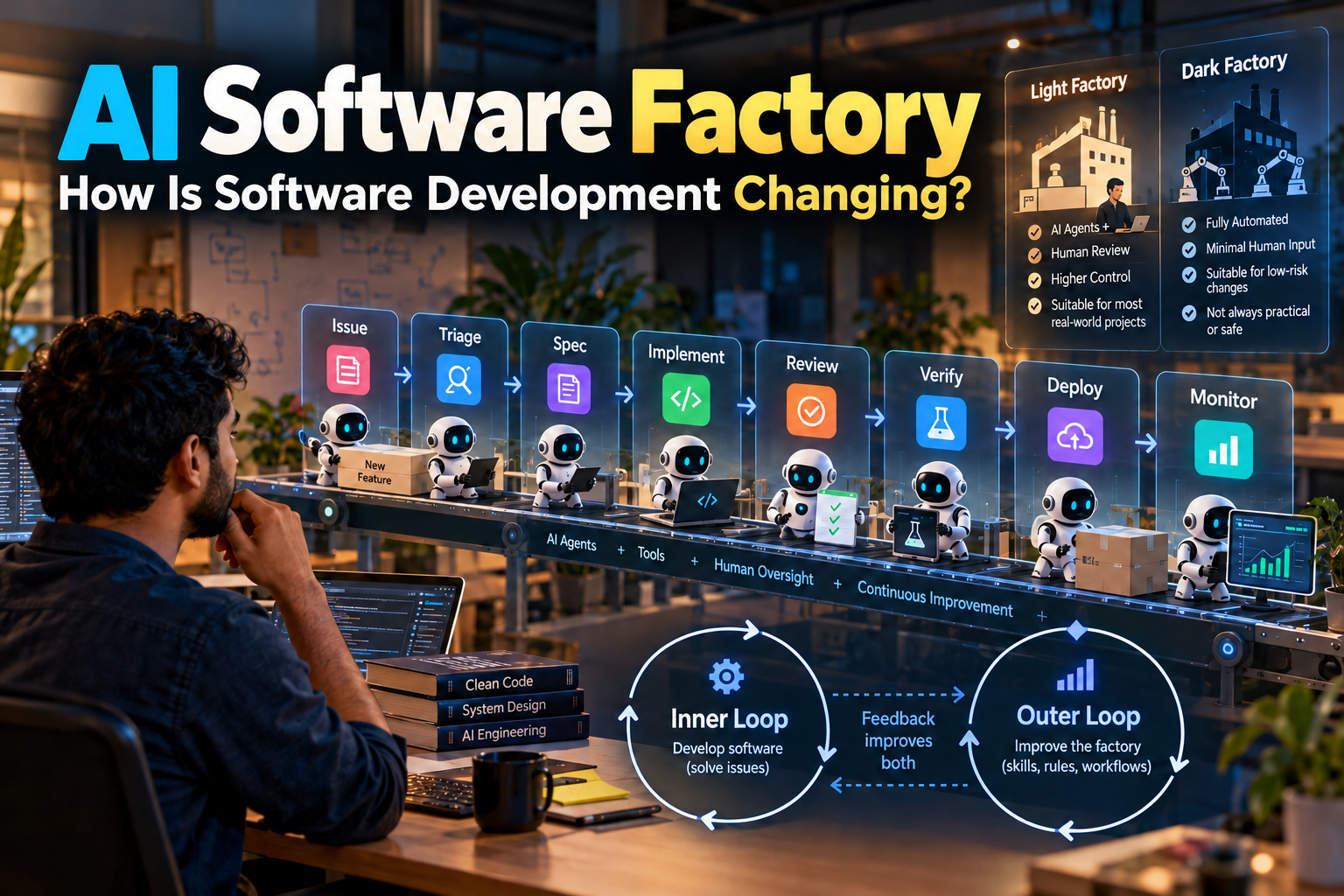
Today, AI coding agents can write code, run tests, fix bugs and create pull requests.
But do we need to prompt and manage agents separately for every one of these tasks?
What if we designed the entire software development lifecycle (SDLC) as an automated workflow?
This is where the concept of an AI software factory becomes important.
What is a software factory?
Put simply, a software factory connects different steps of the development process through AI agents, automated tools and human oversight, creating a repeatable workflow.
For example:
Issue → Triage → Spec → Implement → Review → Verify → Deploy → Monitor
A triage agent analyzes the task. If needed, a specification agent clarifies the requirements. An implementation agent writes the code. Review and verification agents check the results.
The workflow can request human approval for risky changes. After deployment, issues found through monitoring can feed back into the workflow.
How does this differ from an AI harness?
In an earlier article, we discussed AI harness engineering.
An AI harness supplies the environment, tools, context and execution controls an agent needs to operate.
A software factory orchestrates the development workflow from planning through deployment and monitoring. It may use one or several harnesses to do this.
What does an effective software factory need?
- Automation — Orchestrate workflows across agents and tools.
- Context + skills — Provide project knowledge, rules and reusable skills.
- Human in the loop — Require human approval for important decisions and risky changes.
- Self-improvement — Improve skills and workflows using errors, review feedback and performance results.
Light factory vs dark factory
We can think about two ways of running a software factory, depending on its level of automation.
- Light factory — AI agents do the work, with human review and approval as part of the process.
- Dark factory — Activities such as code generation, review and deployment run automatically without routine human intervention.
Not every project is suitable for a fully dark factory.
The concepts of one-way and two-way doors, and blast radius from the previous article can help us automate more low-risk changes while retaining human approval for high-risk changes.
For that reason, a hybrid approach is often more practical.
What is a self-improving factory?
It helps to think in terms of two loops:
- Inner loop — Develop software by resolving issues.
- Outer loop — Improve the factory’s skills, rules and workflows using agent failures, review feedback and metrics.
We continuously improve both the software and the system that creates it. Changes to that system should undergo validation and appropriate human oversight.
How does our focus as software engineers change?
Our goal is to deliver more valuable software while maintaining quality and optimizing human time, token cost, review time and rework, rather than simply generating more code or pull requests.
That requires measuring the factory’s performance, identifying weaknesses and improving its workflows.
This is the key shift in the software factory mindset:
We build software, and we engineer the system that builds the software.
How much of your project’s development workflow do you think could be automated with AI agents? Share your thoughts in a comment.
If this article was useful, share it with a friend. We will explore another technical topic in the next article.