Code Review and Review Tax in the Agentic AI Era — Does Every PR Need the Same Review?
 Tharuka Sarathchandra · Oct 30, 2026 · 2 min read
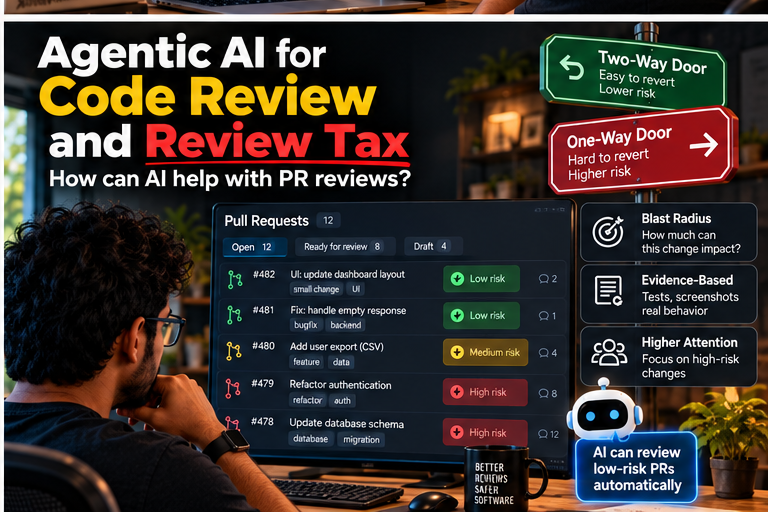
AI coding agents let us generate code and create pull requests very quickly.
But does the speed of reviewing that code and getting it into production increase just as much?
This is where the concept of review tax matters.
As AI-generated PRs multiply, reviewing, validating and correcting them can take more time. Code generation becomes faster, while the overall development process may become slower.
Does every PR need the same attention?
No. A few concepts help us decide how much review a change needs.
1. One-way doors and two-way doors
- Two-way door — A change that can easily be reverted, such as a limited UI change.
- One-way door — A change that is difficult or expensive to reverse, such as deleting production data.
2. Blast radius
How much of the system could the PR affect? Changing a small UI component and changing the authentication system do not carry the same risk.
3. Evidence-based review
An agent saying “tests pass” is not enough. Real evidence, such as test results, screenshots and before/after behavior, matters.
How should the review process change?
For PRs that are low risk, have a small blast radius and are easy to reverse, AI code review, automated tests and CI checks can support reduced human review or auto-merge, within appropriate safeguards.
Changes that are high risk, have a large blast radius or are difficult to reverse need greater attention and human approval.
AI can also help assess risk. Controls that validate those assessments remain important.
What should software engineers focus on?
Our goal is to maintain software quality, allocate review effort according to risk, and move changes safely into production.
Give the most engineering attention to the PRs with the greatest risk, instead of spending the same review time on every PR.
Does your team have a dedicated process for reviewing AI-generated PRs? Share your thoughts.
In the next article, we will discuss the concept of an AI software factory.